
Levels of standardization

Science-Based Selection – CH 2
1. Define measurement as it is used in staffing. Explain why proper measurements of
the candidate’s characteristics are important?
2. Differentiate between different types of measurement scales and measurement errors
(scales: nominal, ordinal, interval, ratio; random vs. systematic errors).
3. Explain the following concepts as they apply to R&S: construct, correlation, cut-off
scores, validity and its types, reliability, bias (including unconscious bias), and
fairness.
4. Recognize common strategies used to achieve and improve the reliability and validity
of the recruitment and selection processes.
a. What standardization is all about? What are the levels of standardization?
[content, administration & scoring]
5. Recognize the difference between scientific and non-scientific ways of acquiring
information.
6. Explain Principles of Assessment and discuss how they are related to the selection.
[reliability, validity, utility, practicality, discriminability, fairness, etc.]
7. Contrast between science and practice-based selection systems. Provide a rationale
for the advantages of using the scientific approach to Recruitment and Selection.
8. Describe the practical steps needed to develop a fair, objective and legally defensible
selection system.
tory standard is a BFOR)
5. Describe ways to ensure Staffing is done “legally” without putting the organization
under undue exposure
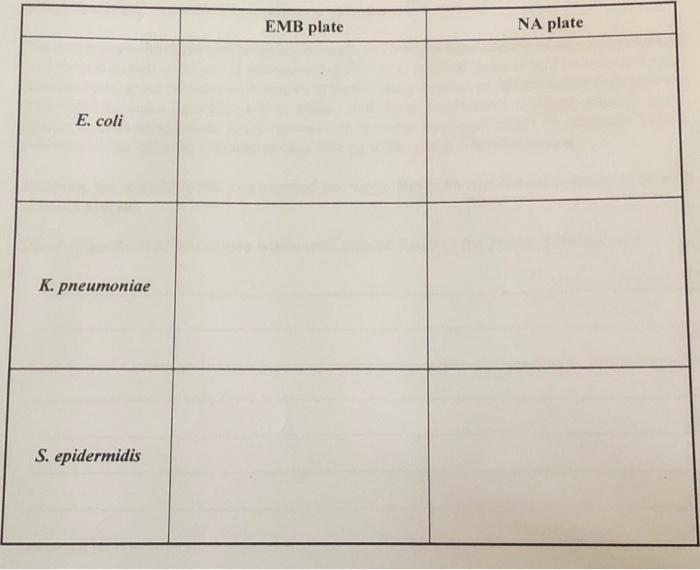
 

Brief description of the cultural characteristics of each of the bacteria

Give a brief description of the cultural characteristics of each of the bacteria on the two different media used ( EMB plate and NA plate)
EMB plate NA plate E. coli K. pneumoniae S. epidermidis

What are the four statistical approaches for phylogenetic reconstruction we discussed in class?

What are the four statistical approaches for phylogenetic reconstruction we discussed in class? Which of them attempt to recapitulate actual evolutionary events? Which would you use to determine the phylogeny of 35 species of rotifer? Please Explain why!

The four statistical approaches for phylogenetic reconstructions are “Distance, Maximum Parsimony, Maximum Likelihood & Bayesian”

Which of the following will cause an increased risk of thrombosis?

Which of the following will cause an increased risk of thrombosis? Select one: O a. Reduction in the amount of antithrombin III in . circulation. O b. An increase in the amount of plasmin in the circulation i O c. Nitric oxide production by endothelial cells O d. Prostaglandin PGI2 production by endothelial cells. e. High levels of fibrin degradation products in the circulation.

Method for improving employee satisfaction and motivation

Pay for Performance Enhances Employee Management at Scripps Health. Scripps Health is a long-standing and prominent nonprofit health-based organization that is based in the greater San Diego area. The organization experienced a severe financial downturn that led to increased employee discontent and turnover, as well as the exit of the firm’s CEO. In an effort to fix these problems, CEO and President Chris Van Gorder implemented a new strategic plan that was used to enhance how the employees were treated. The new strategic plan contained several components that encouraged employees to work more effectively in their jobs. For example, administrators were to utilize a more participatory leadership approach to create “buy-in” among staff members, and a natural extension of this approach was the development of a physician leadership cabinet that improved how personnel interacted with each other, and that strengthened firm coordination through widespread communication. Top managers also focused on improving individual satisfaction and productivity by enhancing work efficiency levels.A major part of these more streamlined operations stemmed from implementation of a beneficial performance management plan. In particular, this plan outlined how managerial talent would be developed, employees would be recognized for a job well done, and motivation would be orchestrated through a competitive compensation approach. Reorganizing the compensation policies of the organization was one of the primary areas targeted for improvement by the firm’s leadership. Part of this redesign process involved periodic reviews of job content, the use of annual appraisals to enhance communication, and the assessment of experience and education to properly adjust compensation amounts. Further, the organization strives to offer competitive compensation that rests at the 65th percentile of the relevant labor markets, which positions the firm squarely in the middle between the top and bottom levels of competitive compensation. The company also tests the pay markets twice a year so that it can remain competitive with regard to compensation. Finally, workers can tap into extra money based on ratings given vis-à-vis the annual performance appraisal sessions; if employees do well on their performance reviews, they can earn as much 5% of their salaries as merit-based compensation.

QUESTIONS
1. Discuss how this case illustrates how compensation can be used as a method for improving employee satisfaction and motivation.
2. Identify some of the ways that performance- based pay systems should be developed based on the experiences at Scripps Health.

Environmental change

Bacteria can generate energy using a variety of different electron transport chain components depending on the environment. a. (3 pts) During what environmental change would a bacterium shift its metabolism from aerobic lithotrophy to aerobic organography? b. (4 pts) Which component of the electron transport chain would change under the environmental conditions of 5a? Why?

Electron transport chain components

Bacteria can generate energy using a variety of different electron transport chain components depending on the environment. a. (3 pts) During what environmental change would a bacterium shift its metabolism from aerobic lithotrophy to aerobic organography? b. (4 pts) Which component of the electron transport chain would change under the environmental conditions of 5a? Why?

Damage to the frontal and temporal lobes of the brain

Rob is a 32-year-old man who was a passenger in a motor vehicle that flipped over. His brain injury resulted in damage to the frontal and temporal lobes of the brain. He developed speech and seizure problems. Rob experiences slowed thinking, aggression, depression, and behaviour disorders. He recently moved from home to a community-based assisted living facility. Rob smokes two packs of cigarettes daily, drinks coffee, and eats sparingly throughout the day. His symptoms include anxiety, irritability, periodic bouts of depression, and poor balance. Rob has expressed a desire to improve his lifestyle and learn the skills necessary to do so.

QUESTION 8

How can staff provide strengths-based support to Rob?


Name the uses of phenol in Dentistry

Name the uses of phenol in Dentistry. What is the phenol coefficient? Another method of microbial control is filtration. List down at least 5 kinds of filters that could be used for this method. Define the following terms: Antiseptic Asepsis Disinfectant Sterilization Bactericidal Bacteriostatic

Discuss the Biosafety Levels.

Discuss the 4 Biosafety Levels. Tabulate your answers with the following categories: Biosafety Level, Description, Sample Organisms, Pathogen Type, Standard Microbiological Practice, Laboratory facility, and safety Equipment