
The evolution of sexual reproduction

After the evolution of sexual reproduction lead to the selection for eggs and sperm, a fundamental asymmetry in reproductive strategies evolved that resulted in sexual selection in many species. Which one (or more) of the following is not a typical consequence of intersexual selection? (Note: points will be deducted for a wrong answer here.) Select one or more: a female choice of mate(s) O b. sperm competition Oc male competition Od infanticide
The role of elongation factors

Describe the elongation phase of translation for the following mRNA. The description should be detailed but does not have to include the role of elongation factors. The description begins with the tRNA for AUG (fMet) tRNA entering the P site on the ribosome and continues the description of the process from there. Make sure you refer to the mRNA sequence below.

Molecular biologist sequences

A molecular biologist sequences the two alleles that are present in a population for some gene of interest. She finds that one allele has an A nucleotide at the third position of a particular codon and the other allele has a mutation to a G at the third position of the same codon. Both codons code for the amino acid proline. Which of the following statements is most likely true of the G mutation in the second allele?

The evolution of darker skin

Modern human populations have adapted to local environmental conditions around the globe. The evolution of darker skin in geographic regions closer to the equator is hypothesized to be beneficial because it (click all that apply) Select one or more: O a redirects energy from the brain to the appendix to facilitate the digestion of cellulose in plants O b. allows for more UV light absorption under relatively lower light levels, which increases Vitamin D production blocks excess UV rays under intense sunlight conditions, which prevents, damage to DNA and destruction of vitamin B in the body d. enables greater night-time vision

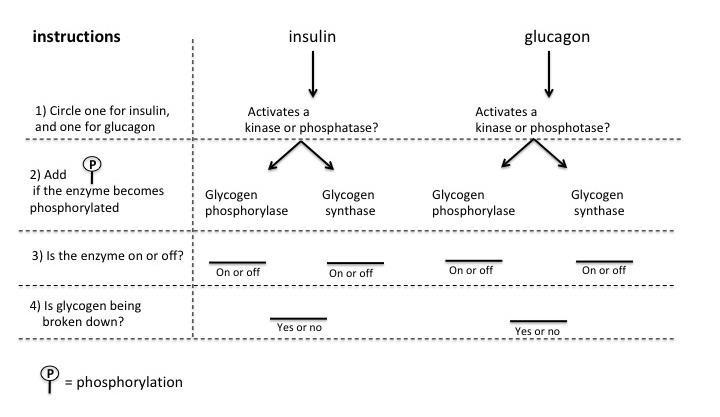
The role of insulin and glucagon in regulating glycogen synthesis

Fill in the diagram below indicates the role of insulin and glucagon in regulating glycogen synthesis or breakdown. When considering if the enzyme is “on or off” you need to consider its phosphorylation state as well.
instructions insulin glucagon 1) Circle one for insulin, and one for glucagon Activates a kinase or phosphatase? Activates a

Avenues of sodium and potassium loss

There are several avenues of sodium and potassium loss. Which of the following statements is correct? o Sweat sodium loss is lower than sweat potassium loss Sweat sodium loss is higher than sweat potassium loss Faecal sodium loss is higher than fecal potassium loss Respiratory sodium loss is lower than respiratory potassium loss

Schematic diagram of the components

Draw a schematic diagram of the components involved in immunoblot testing. 2. How was the anti-mouse IgG-HRP conjugate generated? 3. What result would you expect if a monoclonal antibody of different specificity or pre-immune serum was used in the above experiment? Why? 4. Name two other solid phases suitable for antigen/antibody immobilization. 5. Comment, in detail, on your observations from this practical class.

The electrical signal signals muscle cells

The electrical signal signals muscle cells to contract. b. Results from atrial depolarization and initiates contraction of the atria. c. Results from ventricular repolarization. d. The straight line on the ECG. It is the point of departure of the electrical activity of depolarizations and repolarizations of the cardiac cycles. e. The electrical signal that results from muscle cell ion concentrations “resetting” during relaxation. f. Results from ventricular depolarization and initiates ventricular contraction. g. Depolarization followed by repolarization: the electrical signals that cause the mechanical pumping contraction of heart muscle cells. s inside the blood vessel 5, secondary roads, and aller arteries and then as that finally empty into es and return the blood and branch through the capillaries are the side walls that exchange bet stem of roads, the vascu eart

The uses of phenol in Dentistry

Review questions: Name the uses of phenol in Dentistry. What is the phenol coefficient? Another method of microbial control is filtration. List down at least 5 kinds of filters that could be used for this method. Define the following terms: Antiseptic Asepsis Disinfectant Sterilization Bactericidal Bacteriostatic

Electron transport chain components

Bacteria can generate energy using a variety of different electron transport chain components depending on the environment. a. (3 pts) During what environmental change would a bacterium shift its metabolism from aerobic lithotripsy to aerobic organography? b. (4 pts) Which component of the electron transport chain would change under the environmental conditions of 5a? Why?